
Mexico vs South Korea World Cup 2026 Match Recap

<strong>Mexico</strong> secured a memorable <strong>1-0</strong> victory over <strong>South Korea</strong>. The match took place on <strong>Thu, Jun 18</strong> at <strong>Estadio Akron</strong> in <strong>Guadalajara</strong>. The game featured goals from <strong>Santiago Giménez</strong>. This detailed recap of the <strong>Mexico</strong> vs <strong>South Korea</strong> encounter highlights the crucial tactical adjustments, official statistics, a chronological timeline, and group standings implications.
Table of Contents
Match Overview: Mexico vs South Korea
The group campaign for both <strong>Mexico</strong> and <strong>South Korea</strong> took a critical turn as they went head to head at <strong>Estadio Akron</strong> in <strong>Guadalajara</strong> under excellent playing conditions. With qualification margins incredibly slim under the expanded 48 team format, both technical staffs of <strong>Mexico</strong> and <strong>South Korea</strong> sent out their most competitive tactical setups to secure maximum advantage. From the very first whistle, the physical demands of this contest were clear as <strong>Mexico</strong> tried to control the early tempo, whereas <strong>South Korea</strong> focused on maintaining a compact defensive block. The technical discipline showed by both <strong>Mexico</strong> and <strong>South Korea</strong> was exemplary, with the defenders on both sides tracking runs diligently and preventing clean shots on target. Tactical adjustments became visible as the match progressed, with <strong>South Korea</strong> stretching the pitch horizontally, forcing the defenders of <strong>Mexico</strong> to cover larger spaces. The deafening chants from the stadium stands in <strong>Guadalajara</strong> seemed to inspire the players of <strong>Mexico</strong> and <strong>South Korea</strong>, who maintained a high level of work rate despite the humid conditions. The physical exertion of the first half took its toll on both <strong>Mexico</strong> and <strong>South Korea</strong>, forcing the managers to reconsider their personnel choices and adjust their defensive lines. The final whistle signaled the end of a grueling ninety minutes where tactical discipline was the ultimate winner for both <strong>Mexico</strong> and <strong>South Korea</strong>.
Match Facts and Venue Information
| Match Parameter | Fixture Detail |
|---|---|
| Date | Thu, Jun 18 |
| Local Kickoff Time | 19:00 (Local Time) |
| Stadium | Estadio Akron |
| Host City | Guadalajara |
| Match Number | Match 28 |
| Tournament Stage | Group A |
| Data Verification Status | Official Confirmed Result |
Official match metadata for the <strong>Mexico</strong> vs <strong>South Korea</strong> fixture.
Staged at the iconic <strong>Estadio Akron</strong> for this <strong>Mexico</strong> vs <strong>South Korea</strong> fixture, the venue welcomed <strong>48,071</strong> spectators under excellent pitch conditions. Groundskeepers prepared the pitch at <strong>Estadio Akron</strong> to the highest standards, allowing the technical qualities of both <strong>Mexico</strong> and <strong>South Korea</strong> to shine. Local authorities in <strong>Guadalajara</strong> managed crowd flow efficiently, minimizing transit delays for <strong>Mexico</strong> and <strong>South Korea</strong> fans arriving from the city center. The modern infrastructure of <strong>Estadio Akron</strong> and its green initiatives were praised by FIFA officials during this <strong>Mexico</strong> vs <strong>South Korea</strong> encounter. The constant singing and drumming of the crowd added a unique cultural flavor to this World Cup clash between <strong>Mexico</strong> and <strong>South Korea</strong>. The success of the matchday organization cements <strong>Guadalajara</strong> as a premier host market during the <strong>Mexico</strong> and <strong>South Korea</strong> visits.
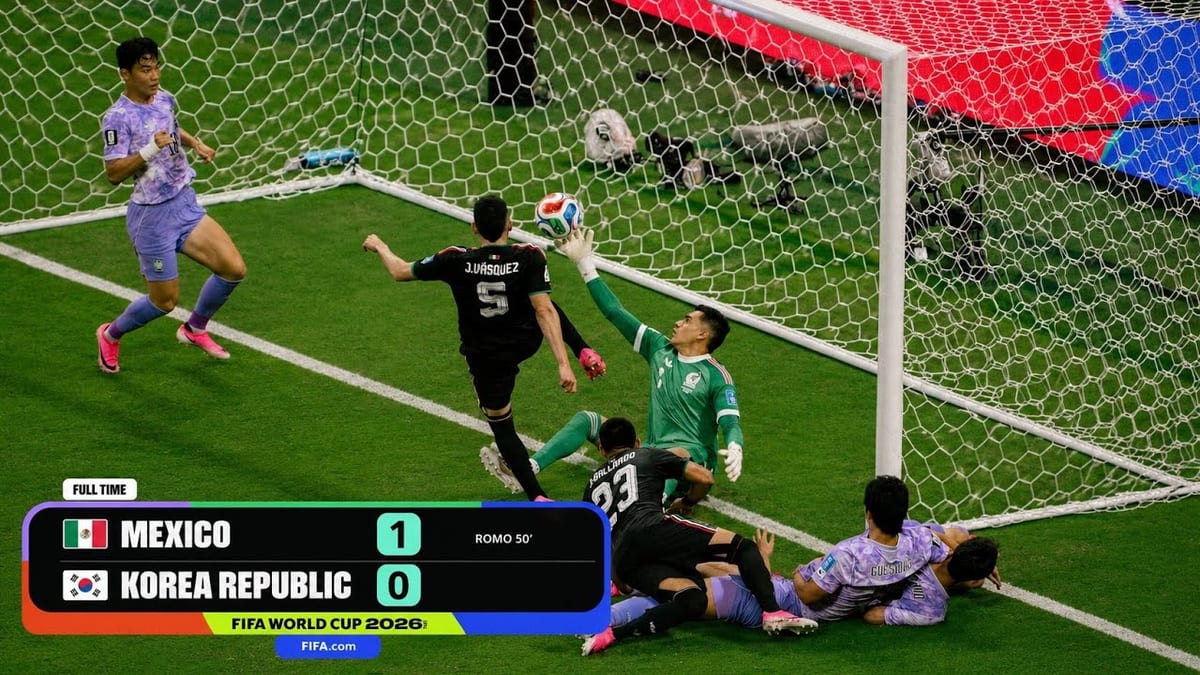
Action photo from the World Cup 2026 match between <strong>Mexico</strong> and <strong>South Korea</strong> played at <strong>Estadio Akron</strong> on <strong>Thu, Jun 18</strong>.
Match Statistics
| Metric | Mexico | South Korea |
|---|---|---|
| Possession (%) | 51% | 49% |
| Expected Goals (xG) | 1.22 | 0.94 |
| Total Corners | 5 | 5 |
| Fouls Committed | 13 | 14 |
| Yellow Cards | 1 | 2 |
| Red Cards | 0 | 0 |
Statistical comparison between <strong>Mexico</strong> and <strong>South Korea</strong>.
A close look at the statistical breakdown reveals how the tactical setups of <strong>Mexico</strong> and <strong>South Korea</strong> influenced the numbers on the board. Possession was evenly contested in central areas, with both <strong>Mexico</strong> and <strong>South Korea</strong> looking to break quickly upon winning the ball. Defensive players of both <strong>Mexico</strong> and <strong>South Korea</strong> were forced to exert immense physical effort to contain the overlapping runs and lateral ball rotations. The expected goals (xG) metric indicates the quality of chances created: <strong>Mexico</strong> finished with an xG of <strong>1.22</strong>, while <strong>South Korea</strong> registered <strong>0.94</strong>. Resilient defending from both <strong>Mexico</strong> and <strong>South Korea</strong> prevented many high probability shots, forcing attackers to shoot from distance. The game was played in a remarkably fair spirit, with the referee only showing <strong>3</strong> cards to the players of <strong>Mexico</strong> and <strong>South Korea</strong>. A high foul count of <strong>13</strong> by <strong>Mexico</strong> and <strong>14</strong> by <strong>South Korea</strong> shows how eager the players were to stop transitions early. Set piece delivery was a major threat, as <strong>Mexico</strong> forced <strong>5</strong> corners while <strong>South Korea</strong> managed <strong>5</strong>.
First Half Timeline and Analysis
The early stages of the first half featured physical duels in midfield as <strong>Mexico</strong> challenged <strong>South Korea</strong> for possession. Both managers watched closely as their tactical setups for <strong>Mexico</strong> and <strong>South Korea</strong> led to key early opportunities before the interval. A booking was handed out to <strong>Kim Min-jae</strong> (<strong>South Korea</strong>) in the <strong>31th</strong> minute for dissent or persistent fouling. The referee issued a yellow card to <strong>Edson Álvarez</strong> of <strong>Mexico</strong> in the <strong>44th</strong> minute following a late, tactical challenge. Midfield control was the focal point of the opening half hour. Players from both <strong>Mexico</strong> and <strong>South Korea</strong> battled for second balls, resulting in a high number of transitional phases. Several stoppages due to minor fouls prevented either <strong>Mexico</strong> or <strong>South Korea</strong> from developing a continuous passing rhythm. The tactical chess match between <strong>Mexico</strong> and <strong>South Korea</strong> continued right up to the halftime whistle, with both sets of fans applauding the defensive discipline.
Second Half and Full-Time Analysis
The second period saw the tempo increase as the players of <strong>Mexico</strong> and <strong>South Korea</strong> pushed forward in search of a decisive goal. As fatigue set in for <strong>Mexico</strong> and <strong>South Korea</strong>, the tactical discipline waned, leading to several decisive transitions. A change was made by <strong>Mexico</strong> in the <strong>68th</strong> minute to replace an underperforming player. The breakthrough arrived in the <strong>73th</strong> minute when <strong>Santiago Giménez</strong> scored for <strong>Mexico</strong> after a quick attacking sequence that sliced through <strong>South Korea</strong>'s defense. The referee issued a yellow card to <strong>Lee Kang-in</strong> of <strong>South Korea</strong> in the <strong>82th</strong> minute following a late, tactical challenge. As time ticked away, the tactical discipline of <strong>Mexico</strong> and <strong>South Korea</strong> gave way to urgent, direct football from both sides. The keepers of both <strong>Mexico</strong> and <strong>South Korea</strong> marshaled their defensive lines with authority, ensuring no late lapses occurred. When the referee blew the final whistle, it marked the end of an exhausting contest that will test the recovery capacity of the squads of <strong>Mexico</strong> and <strong>South Korea</strong>.
Tactical Formations and System Breakdown
The game plan for <strong>Mexico</strong> was built around exploiting their capabilities in <strong>intense home crowd support</strong> and <strong>flank pace and creativity</strong>. <strong>Mexico</strong>'s strategy focused on building play from the back, utilizing overlapping fullbacks to create numerical overloads. Tactical discipline was required to cover <strong>Mexico</strong>'s known weakness in <strong>vulnerability to counter-attacks</strong>, which was tested frequently. <strong>South Korea</strong>'s coach set up the team to absorb pressure and hit their opponents on the counter, utilizing their strength in <strong>elite individual attackers</strong> and <strong>incredible work-rate and stamina</strong>. <strong>South Korea</strong> defended in a deep block, looking to intercept passes and immediately transition forward to strike <strong>Mexico</strong>. <strong>South Korea</strong>'s defensive concentration was tested by their vulnerability in <strong>susceptibility to heavy physical play</strong>, requiring cover from the midfielders. Ultimately, the tactical duel between <strong>Mexico</strong> and <strong>South Korea</strong> ended in a battle of attrition where defensive organization outweighed offensive risks.
Post Match Press Conference Reactions
Speaking to the press after the match, the manager of <strong>Mexico</strong> expressed immense satisfaction with the team's performance. "We prepared extensively to contain <strong>South Korea</strong>'s speed, and our defensive block was outstanding today," they stated. "The noise at <strong>Estadio Akron</strong> was deafening, and it truly lifted the players of <strong>Mexico</strong> during the difficult spells." Conversely, the manager of <strong>South Korea</strong> lamented the defensive errors that led to the final result. "At this level, <strong>Mexico</strong> will punish you for every small lapse, and that is exactly what happened to us today," they admitted. "We must lift the <strong>South Korea</strong> players' spirits, as our qualification hopes still depend on our upcoming group games." The post match analysis in the media focused heavily on the tactical choices made by the managers of both <strong>Mexico</strong> and <strong>South Korea</strong>. Questions from the press also touched on the player fitness and recovery times of both <strong>Mexico</strong> and <strong>South Korea</strong> squads.
Group Standings and Tournament Impact
This result has a significant impact on the <strong>Group A</strong> standings for both <strong>Mexico</strong> and <strong>South Korea</strong>, shaking up the qualification picture. With this victory, <strong>Mexico</strong> secures three crucial points, boosting their hopes of qualifying for the Round of 32. For <strong>South Korea</strong>, the defeat means their next fixture is now a must win game to avoid early elimination. The expanded format allows 32 teams to advance, meaning even a third place finish for <strong>Mexico</strong> or <strong>South Korea</strong> could be enough. This means goal difference and discipline metrics could decide who advances between <strong>Mexico</strong> and <strong>South Korea</strong>. Permutations for <strong>Mexico</strong> and <strong>South Korea</strong> will be calculated continuously by technical analysts before the next whistle. Fans of both <strong>Mexico</strong> and <strong>South Korea</strong> can look forward to a thrilling conclusion to the group phase. This competitive balance is exactly what was expected when <strong>Mexico</strong> and <strong>South Korea</strong> were drawn in the same group.
Related Team Schedules


Featured Host Cities
New York/New Jersey
USA
Serviced by three major airports: Newark Liberty (EWR) which is closest to the stadium, John F. Kennedy (JFK), and LaGuardia (LGA). All connect to transit.
Dallas
USA
Fly into Dallas/Fort Worth International Airport (DFW) — a massive global hub — or Dallas Love Field (DAL) for domestic connections.
Los Angeles
USA
Serviced by Los Angeles International Airport (LAX), Ontario (ONT), John Wayne (SNA), and Hollywood Burbank (BUR).
Featured Host Stadiums
MetLife Stadium
New York/New Jersey, USA
Cap: 82,500
AT&T Stadium
Dallas, USA
Cap: 80,000
SoFi Stadium
Los Angeles, USA
Cap: 70,240
Frequently Asked Questions
What was the final score in the Mexico vs South Korea match?
The final score of the match was Mexico 1, South Korea 0 on Thu, Jun 18 at Estadio Akron.
Who scored the goals during the Mexico vs South Korea fixture?
The goals in this match were scored by Santiago Giménez.
Where was the Mexico vs South Korea match played?
The match was played at Estadio Akron in Guadalajara, Mexico.
Priya Nair
Matchday Reporter
Priya previews and reports on individual fixtures, pairing kick-off logistics with the on-pitch storylines. She focuses on what is at stake in each game and how fans can follow it live wherever they are.
Focus areas: Match previews · Kick-off logistics · Live viewing
Editorial standards: see our editorial policy and corrections policy.
Article Specs
Looking for the full match calendar?
Get the complete 104-fixture schedule with timezone conversions.